Block Out! Tips and Tricks for Beginners
Master Block Out! faster with this beginner's guide: gate sequencing, parking moves, booster usage, and the mistakes that trap most new players.
Block Out! Tips and Tricks for Beginners
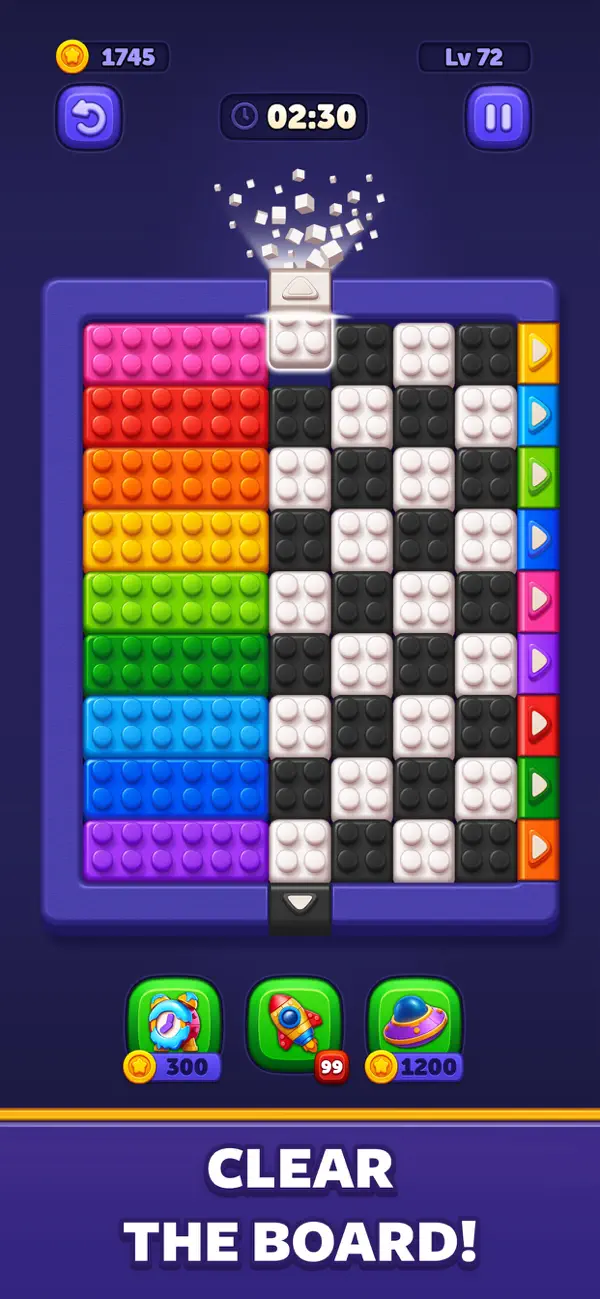
Block Out! looks simple — push colored blocks through matching gates — but the levels get hard fast. By level 30 you'll find yourself staring at a board for two minutes before making a single move. By level 50 you'll be retrying levels six or seven times.
This guide collects the tactics that actually move the needle for new players. None of these are obscure tricks; they're the habits that separate someone who solves a level in three tries from someone who solves it on the first attempt.
1. Read the board before you move anything
This is the single most important habit. Most failures in Block Out! happen because a player slid the first piece they noticed instead of the first piece they should have moved.
Before your first move, identify:
- Every gate's color — note the position and color of each exit
- Which blocks are pinned — blocks that can't move until something else moves first
- Choke points — the narrowest part of the board, usually near the center
If two pieces both want the same lane, decide who goes first before you start sliding. Reversing a wrong choice usually costs you 4–5 moves you didn't need to spend.
2. Solve gates in dependency order, not visual order
Beginners tend to solve from top to bottom or left to right. That's almost never right.
The correct order is dependency order: which block, if removed first, would unlock the most other blocks? That's your starting move.
For example, if a long blue piece is wedged across the middle of the board, it's probably blocking 3–4 other pieces. Get the blue piece out first — even if it seems harder — because everything else gets easier afterward.
3. Use "parking moves" — don't be afraid to move backward
A parking move is when you slide a piece away from its gate just to clear a path for another piece. New players resist this because it feels like wasted effort.
It isn't. Parking is one of the core mechanics of color-sort puzzles. The optimal solution to many Block Out! levels involves moving a piece two or three squares in the wrong direction first, then routing it back later.
If you're stuck and every piece seems to want the same lane, look for a piece you can park temporarily. The board will open up.
4. Plan three moves ahead, not just one
Easy levels (1–10) are forgiving — you can play move-by-move and still solve them. Past level 15, that approach falls apart.
The shift to make: before you slide a block, ask yourself "what does the board look like after this move, and what does my next move look like?" If you can't see two clean moves ahead, the move you're about to make is probably wrong.
This sounds slow. It's actually faster, because every wrong move costs you an undo and a retry.
5. Use undo, not restart, when you're learning a level
Block Out! gives you an undo button. Use it.
If you make a move and immediately realize it was wrong, undo it — don't restart the level. Restarting wipes your mental map of the board. Undoing keeps your progress and lets you try the alternative.
Save restarts for when you're 4+ moves deep into a clearly broken plan. Then it's worth starting fresh.
6. Watch the video walkthrough at 0.5x speed for hard levels
For Hard, Expert, or Super Hard levels, our video walkthroughs cover every level. But there's a trick to using them well: don't watch at full speed.
Drop to 0.5x speed and watch the first 5 moves only. Those moves usually define the entire solution. Once you understand the opening, pause the video and try to finish on your own. You'll learn faster than if you copy every move.
7. Recognize the three failure patterns
Most stuck levels fall into one of three patterns:
Pattern A: "Box-in" — You moved a block that's now trapped between two others, with no way out. Fix: undo immediately. If you can't, restart.
Pattern B: "Gate collision" — Two pieces want the same gate and you committed to the wrong one. Fix: there's almost always a parking move that fixes this. Look for an empty cell that can hold the wrong-order piece.
Pattern C: "Long-piece runway" — A long horizontal or vertical piece needs a clear lane and you filled the lane with smaller pieces. Fix: undo back to before you blocked the lane. Long pieces should usually move first.
Recognizing which pattern you're in saves you minutes per level.
8. Don't burn boosters on Easy levels
Block Out! gives you free boosters and lets you earn more by playing. New players often spend them on Easy levels (1–20) because the boosters are flashy.
Save them. By level 50 you'll genuinely need every booster you have, and earning more gets harder. Treat coins and boosters like an emergency fund.
9. Take breaks on Super Hard levels
Super Hard levels are designed to be retry-heavy. If you've failed the same level 5+ times in a row, your brain has locked into a wrong mental model and you're not going to solve it by trying again.
Close the app. Come back in 30 minutes. The solution often becomes obvious on the first attempt after a break — your fresh eyes spot the dependency you missed.
10. Learn the "lock piece" concept
Every hard level has a lock piece — the one block that, until it moves, traps everything else. Identifying the lock piece is the single biggest unlock (pun intended) you can make.
The lock piece is usually:
- A long piece spanning the middle
- A piece in the densest corner
- A piece whose only path crosses every other gate
Once you've identified the lock piece, your entire plan becomes "how do I move the lock piece, and what setup do I need to do that?" Everything else slots into place around that.
Putting it all together
You don't have to apply all ten tips at once. Pick two or three for your next session — say, read the board first and use undo, not restart — and let them become habit. The other tips will fall into place naturally as the levels get harder.
Block Out! rewards patience. The players who finish level 200 aren't faster than the players who quit at level 50; they're just better at slowing down before the first move.
For level-specific solutions, our video walkthrough index covers every level from 1 to 200.
Quick reference
- Read first, move second.
- Solve in dependency order.
- Park pieces — backward moves are fine.
- Plan three moves ahead.
- Undo > restart for single mistakes.
- Drop video to 0.5x for hard levels.
- Save boosters for level 50+.
- Take a break after 5 failures.
- Find the lock piece.
- Long pieces need clear runways.
Good luck out there.